Ever started cooking a recipe only to discover it uses cups instead of grams, or Fahrenheit instead of Celsius? It happens all the time, especially when switching between American and British recipes.
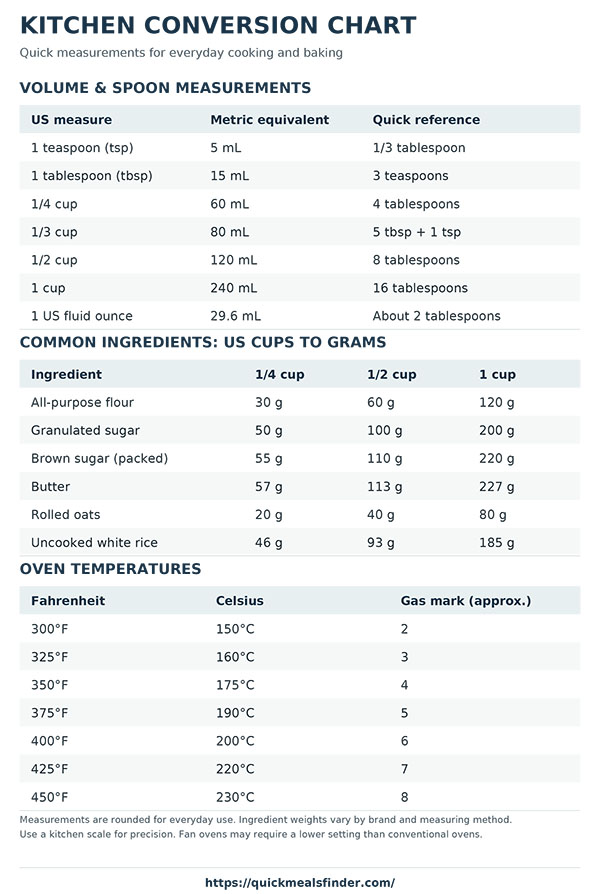
That’s exactly why I’ve put together this free kitchen conversion chart printable. It includes everyday cooking measurements, common ingredient weights, and oven temperature conversions, all on one easy-to-read A4 page.
You can download the PDF, print it, and keep it in your kitchen drawer or stick it inside a cupboard door for quick reference.
Download Your Free Kitchen Conversion Chart PDF
Download US Letter PDF | Download A4 PDF
Our printable includes:
- US cups, tablespoons and teaspoons converted to millilitres.
- Cups to grams for six common cooking and baking ingredients.
- Fahrenheit to Celsius oven temperature conversions.
- Approximate gas mark equivalents.
- A clean, printer-friendly layout without unnecessary graphics.
The chart is designed for A4 paper (210 × 297 mm) and can be printed in black and white.
Tip: Save the PDF to your phone as well, so you can quickly check measurements while shopping or cooking.
Kitchen Measurement Conversion Chart: Cups, Tablespoons & Millilitres
American recipes commonly measure ingredients using cups, tablespoons and teaspoons. In the UK and many other countries, recipes often use grams and millilitres instead.
This quick kitchen conversion chart makes switching between the two systems much easier.
| US Measurement | Metric Equivalent | Quick Reference |
|---|---|---|
| 1 teaspoon (tsp) | 5 mL | ⅓ tablespoon |
| 1 tablespoon (tbsp) | 15 mL | 3 teaspoons |
| ¼ cup | 60 mL | 4 tablespoons |
| ⅓ cup | 80 mL | 5 tbsp + 1 tsp |
| ½ cup | 120 mL | 8 tablespoons |
| 1 cup | 240 mL | 16 tablespoons |
| 1 US fluid ounce | 29.6 mL | About 2 tablespoons |
These are rounded US cooking measurements. A US cup is approximately 237 mL, commonly rounded to 240 mL for everyday cooking.
An important detail is that a US cup and a metric cup aren’t exactly the same. A metric cup is 250 mL, so always check which measurement system your recipe uses.
For soups, sauces and everyday dinners, small differences may not matter much. For baking, however, accurate measurements can make a noticeable difference.
Download US Letter PDF | Download A4 PDF
Cups to Grams Conversion Chart for Common Ingredients
One of the most confusing parts of following recipes is converting cups into grams.
Unlike liquid measurements, there isn’t one universal cups-to-grams conversion. A cup of flour weighs much less than a cup of sugar, even though both take up the same amount of space.
Here’s a handy reference for common ingredients.
| Ingredient | ¼ Cup | ½ Cup | 1 Cup |
|---|---|---|---|
| All-purpose flour | 30 g | 60 g | 120 g |
| Granulated sugar | 50 g | 100 g | 200 g |
| Brown sugar (packed) | 55 g | 110 g | 220 g |
| Butter | 57 g | 113 g | 227 g |
| Rolled oats | 20 g | 40 g | 80 g |
| Uncooked white rice | 46 g | 93 g | 185 g |
These measurements are approximate and may vary depending on the ingredient, brand and measuring method.
How Many Grams Are in a Cup of Flour?
One US cup of all-purpose flour weighs approximately 120 grams when measured using the spoon-and-level method.
If you scoop flour directly from the bag, you can accidentally pack too much into the measuring cup. This can make cakes, pancakes and other baked goods heavier or drier than intended.
For more consistent results, gently spoon the flour into your cup and level it off with a straight edge. Better still, use a kitchen scale.
How Many Grams Are in a Cup of Sugar?
One US cup of granulated sugar weighs approximately 200 grams, while a cup of packed brown sugar weighs around 220 grams.
Brown sugar is normally pressed into the measuring cup, which explains why its weight differs from granulated sugar.
View our Grams to Cups Converter
How Much Butter Is in One Cup?
One US cup of butter weighs approximately 227 grams, equivalent to two standard US sticks of butter.
If you’re following an American baking recipe and only have a kitchen scale, weighing the butter is usually much easier than trying to measure it in cups.
Oven Temperature Conversion Chart: Fahrenheit to Celsius
Oven temperatures are another common source of confusion when using recipes from different countries.
American recipes generally use Fahrenheit, while British and European recipes often use Celsius or gas marks.
Here’s the oven temperature conversion chart included in the free PDF.
Download US Letter PDF | Download A4 PDF
| Fahrenheit | Celsius | Gas Mark (Approx.) |
|---|---|---|
| 300°F | 150°C | 2 |
| 325°F | 160°C | 3 |
| 350°F | 175°C | 4 |
| 375°F | 190°C | 5 |
| 400°F | 200°C | 6 |
| 425°F | 220°C | 7 |
| 450°F | 230°C | 8 |
What Is 350°F in Celsius?
350°F is approximately 175°C, one of the most frequently used baking temperatures in American recipes.
It’s commonly used for cakes, cookies, casseroles and oven-baked dinners.
If you’re using a fan-assisted oven, you may need to reduce the temperature by around 20°C compared with a conventional oven, unless the recipe already specifies a fan setting.
Always check your oven manufacturer’s guidance, as appliances can vary.
Should You Use Cups or Grams When Cooking?
Both methods work, but each has its advantages.
Cups are convenient for everyday cooking. When making soups, casseroles, sauces or simple dinners, measuring ingredients by volume is usually quick and practical.
Grams are more reliable for baking. Flour, sugar and other baking ingredients can vary in weight depending on how they’re measured. Using a scale gives you more consistent results.
For example, when making a casserole, adding a little extra cheese or rice probably won’t ruin the dish. But adding too much flour to a cake can completely change its texture.
If you’re regularly cooking from American and European recipes, keeping a printable kitchen conversion chart nearby saves time and helps avoid mistakes.
Tips for Accurate Kitchen Measurements
Even with a conversion chart, a few simple habits can improve your cooking results.
- Use proper measuring spoons: Ordinary teaspoons and tablespoons from your cutlery drawer aren’t necessarily standard sizes.
- Level dry ingredients: For flour and sugar, use a straight edge to remove any excess.
- Measure liquids at eye level: Place the measuring jug on a flat surface before checking the amount.
- Check whether cups are US or metric: The difference can matter, particularly in baking.
- Weigh ingredients when precision matters: A digital kitchen scale is especially useful for bread, cakes and pastries.
- Check your oven type: Fan-assisted ovens and conventional ovens may need different temperature settings.
Keep This Free Kitchen Conversion Chart Handy
You don’t need to memorise every measurement when cooking. A simple printable reference makes it much easier to follow recipes, particularly when you’re using ingredients and measurements from different countries.
Our free kitchen conversion chart printable brings together the most useful everyday conversions on one A4 page.
Download US Letter PDF | Download A4 PDF
You can print it for your kitchen, save it on your phone or keep a copy alongside your favourite recipes.
And if you’re wondering what to cook with the ingredients you already have, visit QuickMealsFinder.com to discover easy meal ideas and make better use of what’s in your fridge and pantry.
Frequently Asked Questions
Is this kitchen conversion chart printable free?
Yes. The kitchen conversion chart is completely free to download as a PDF. You can print it on standard A4 paper for personal use.
What size is the printable kitchen conversion chart?
The PDF is designed for A4 paper, measuring 210 × 297 mm. If you’re printing on US Letter paper, select your printer’s fit-to-page option to avoid cutting off the edges.
Is one cup always 240 grams?
No. One US cup is approximately 240 millilitres in volume, but its weight in grams depends on the ingredient. For example, one cup of flour weighs around 120 grams, while one cup of granulated sugar weighs around 200 grams.
How many tablespoons are in one cup?
There are 16 US tablespoons in one US cup. One US tablespoon is approximately 15 millilitres.
Can I use this conversion chart for baking?
Yes. It provides useful approximate measurements for common baking ingredients. For recipes requiring precision, use a kitchen scale and follow the ingredient weights supplied by the recipe author.
Does the chart include oven temperatures?
Yes. It includes common oven temperatures from 300°F to 450°F, with Celsius and approximate gas mark equivalents.